B2B Funnels: The Definitive Breakdown for Founders and Growth Teams Who've Outgrown the Basics

5 min read
Most B2B teams can describe their funnel. Few can explain why it works — or why it falls apart the moment they try to scale it. They know the stages. They know the vocabulary. But when conversion rates slip or CAC starts climbing, the diagnosis is usually guesswork dressed up as analysis.
This guide cuts through that. It covers what a B2B funnel actually is, how to choose the right model for your market, what the metrics are actually telling you, and how to design a funnel that holds up under real growth pressure — not just in the deck you show investors.
What Is a B2B Funnel?
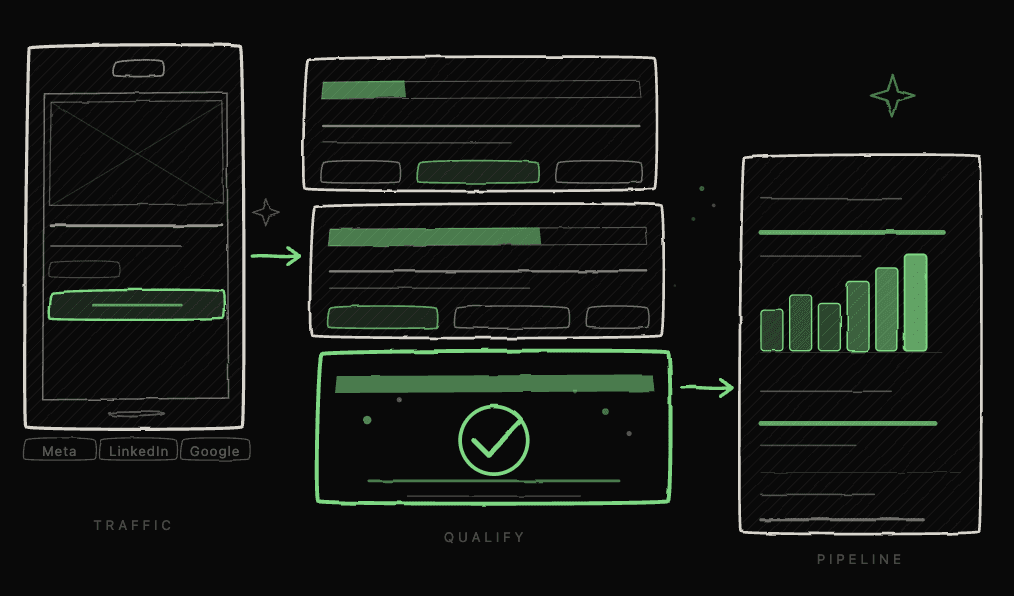
A B2B funnel is the structured process a business uses to move potential buyers from first awareness to becoming a paying customer and ideally, staying one.
It spans marketing, sales, and onboarding. It reflects the reality that B2B buying is slow, involves multiple people, and requires a level of trust that doesn't come from a single ad or landing page. At its best, a funnel makes revenue predictable. At its worst, it gives you the illusion of control while the real problems accumulate out of sight.
What distinguishes a funnel from a loose collection of tactics is structure. Each stage has a clear purpose, a measurable output, and a defined handoff to the next. When one stage breaks, you know where to look. When everything is working, you know what's actually driving it.
Why B2B Funnels Matter
Growth without structure is fragile.
Without a clearly defined funnel, sales and marketing optimise toward different outcomes and never quite resolve the tension. Conversion rates are hard to diagnose because no one agrees on what's being measured. Increasing spend produces unpredictable returns — sometimes growth, sometimes expensive noise. Unit economics quietly degrade while surface metrics look fine.
A well-designed funnel changes the nature of those conversations. It creates predictable lead flow, clear benchmarks, and genuine alignment across teams. It means that when you decide to double your paid budget or hire two more AEs, you have a grounded view of what that investment will produce — because you understand what the machine does with more input.
Funnels don't just drive growth. They make growth repeatable. And repeatability, at scale, is worth more than almost any individual tactic.
How B2B Funnels Differ From B2C
The surface mechanics of a B2B and B2C funnel look similar. The underlying dynamics are not.
B2B buyers rarely purchase on impulse. The decision to adopt a new tool, platform, or service involves research, internal alignment, and timing that often has nothing to do with how compelling your messaging is. Budget cycles matter. Priorities shift. Buying committees form and dissolve. The person who discovers your product, the person who will use it daily, and the person who signs off on the budget are frequently three different people — each with different concerns, different risk tolerances, and different proof points they need before they'll say yes.
Price points are higher. Switching costs are real. The consequences of a bad decision are visible inside the business, which means the bar for trust is genuinely higher than in consumer contexts. And in most B2B funnels, human interaction enters the picture at some stage — even in products that are nominally self-serve.
This is why simple traffic-to-checkout models rarely translate. The complexity isn't incidental. It's the thing you're designing around. A B2B funnel that ignores this ends up optimising for the wrong signals at every stage.
The Core Stages of a B2B Funnel
While the specific mechanics vary significantly by business, most B2B funnels move through five stages. Understanding what each stage is actually trying to accomplish — not just what happens in it — is what separates teams that can optimise intelligently from teams that change things at random and hope for improvement.
Awareness
The buyer recognises a problem or opportunity. They are not looking for you yet. They're looking for understanding — trying to name what's happening in their business and figure out whether it's worth solving. Content, paid media, partnerships, and word of mouth are the primary channels here. Your job at this stage is not to sell. It's to be present, credible, and useful when the question forms.
Consideration
The buyer starts evaluating options. They've identified the problem and they're now building a view on how to solve it. This is where educational content, detailed case studies, webinars, comparison pages, and clear product positioning do their work. The goal isn't to close — it's to stay credible while they form their shortlist and to give them the evidence they need to advocate for you internally.
Conversion
The buyer takes a meaningful action toward purchase: booking a call, starting a trial, requesting pricing, or creating an account. This is your first real signal of genuine intent, and it's where most funnel optimisation effort should sit. Friction at this stage is expensive. A conversion point that's unclear, slow, or poorly sequenced leaks value at exactly the moment you've earned attention.
Close
The buyer commits and becomes a customer. Depending on your model, this involves a sales conversation, contract negotiation, internal procurement processes, or some combination of all three. The time and friction involved here is frequently underestimated — especially for teams scaling into enterprise for the first time. This stage is where deal velocity matters and where sales process rigour pays off most directly.
Retention and Expansion
In B2B, the funnel does not end at purchase. It often doesn't even reach its most valuable point until well after the initial close. Retention protects the revenue you've already earned. Upsell and expansion — cross-selling additional seats, products, or tiers — are frequently the highest-margin growth lever available to a scaling SaaS business. Teams that treat post-purchase as outside the funnel leave significant revenue on the table.
The Main Types of B2B Funnel
There is no universal model. The right funnel depends on your price point, your buyer's sophistication, how quickly your product delivers demonstrable value, and the complexity of the problem you're solving. The biggest mistake teams make is copying a funnel from a company they admire without asking whether their market actually behaves the same way.
Lead-to-Demo
The traditional enterprise model. Leads convert into sales calls or product demonstrations before making any commitment. Works best for high-ACV products, complex offerings with significant implementation requirements, and relationship-driven sales where buyers need reassurance — not just information — before they'll move forward. The risk here is funnel length: too many steps between interest and conversation and you lose buyers who were genuinely qualified.
Trial-Based
Prospects experience the product before deciding. This works well when time-to-value is short — when a buyer can get a meaningful result within a trial window without significant setup investment. Common in product-led SaaS at mid-market price points. The trial becomes the sales conversation. The risk is that free usage without activation creates a pipeline of unqualified trial accounts that looks healthy but converts poorly.
Self-Serve
Users convert without direct sales involvement. Works when the problem is well-defined, the value proposition is immediately obvious, and the path from sign-up to value is genuinely frictionless. Rarely works as well as expected when it's chosen primarily because the team wants to avoid building a sales function. Self-serve requires significant investment in onboarding, in-product guidance, and support infrastructure — the sales cost doesn't disappear, it just moves.
Hybrid
Combines a self-serve entry point with a sales-led expansion motion. Often the right answer for scalable SaaS businesses with tiered pricing: let individuals adopt on a free or low-cost plan, then convert teams and enterprise accounts through a human sales process once usage and intent are established. The challenge is knowing precisely when and how to trigger that handoff without disrupting momentum.
Calls, Trials, or Self-Serve: How to Choose
The decision should follow buyer readiness — not trends, not what your competitors are doing, and not what your team finds operationally convenient.
Sales calls work best when buyers already understand the category and the problem, and what they need is validation before committing. They're in the market. They know roughly what they want. The call adds context, handles objection, and accelerates a decision that was already forming.
Product trials work best when the product can make the case better than a salesperson can — when experiencing the value firsthand removes more doubt than any amount of conversation would. The key question is not whether you can build a trial, but whether your buyer can reach a meaningful outcome within the trial window without significant hand-holding.
Self-serve works best when the decision is low-risk, the buyer is product-sophisticated, and the path to value is genuinely obvious. It also works best when you've already done the work to understand exactly where users drop off and why — and have systematically removed that friction.
Most funnel failures don't come from executing a model badly. They come from choosing a model that doesn't fit the market — usually because another company made it look easy.
The Metrics That Actually Matter
Funnel health isn't captured by conversion rate alone. The numbers that matter are the ones that tell you whether your economics improve or degrade as volume increases — not just whether the top of the funnel is growing.
Track lead-to-opportunity conversion and understand what drives variance in it. Track show-up rates for demos and sales calls — a high booking rate with poor show-up is a qualification problem, not a scheduling one. Track time-to-close across deal sizes and sources. Track cost per acquisition by channel, not just in aggregate, because blended CAC hides the channels that are quietly destroying your unit economics. Track payback period as a function of the ACV you're actually closing, not the ACV you're targeting.
Most importantly, track whether the metrics improve as you scale. A healthy funnel gets more efficient over time. A broken one holds steady or deteriorates — and the gap between what the dashboard shows and what's actually happening only grows.
Why B2B Funnels Break at Scale
Most funnels don't fail at launch. They fail during growth — and the failure is usually slow enough that it gets rationalised as a market problem or a macro environment problem before it gets diagnosed as a funnel problem.
Lead quality declines as spend increases and you exhaust your highest-intent audiences. The leads that worked at £10k/month in ad spend don't look the same at £100k/month. Sales and marketing drift apart in what they're optimising for, each team responding rationally to their own incentives in ways that produce irrational outcomes in aggregate. Over-reliance on a single channel creates fragility — one algorithm change, one competitor entering the auction, one shift in intent patterns and the pipeline dries up. Friction accumulates in later funnel stages where no one is looking because the top-of-funnel numbers still look fine. Metrics get optimised in isolation: CPL goes down, close rate goes down too, nobody connects the two.
The architecture that got you to your first million in revenue is rarely the architecture that gets you to ten. Funnels that work early can become the ceiling that caps you later — not because they were poorly designed, but because they were designed for a different problem at a different scale.
How to Design a Funnel That Holds Up
The strongest B2B funnels are designed backwards. Not from the top of the funnel down, but from the revenue outcome you need and working backwards through every constraint that stands between you and it.
Start with revenue targets, sales capacity, realistic payback period constraints, and an honest assessment of how your buyers actually behave — not how you wish they behaved. What does your buyer already believe when they arrive? What do they need to see before they'll consider a conversation? What makes them delay? What makes them say no at the last stage?
Then design the qualification logic that filters for buyers who are ready. Design the messaging that speaks to what they already believe. Design the conversion points that reduce friction at the exact moments it costs you most. Decide where human sales involvement adds genuine leverage — where a person changes the outcome versus just adding to the cost.
Built this way, a funnel is resilient. When something breaks, you know where to look and why. When you decide to scale, you have a grounded view of what more input will produce. And when the market shifts, you have a structure that can adapt rather than a collection of tactics with no connective logic.
Common Questions
What is the best B2B funnel?
The one that fits your buyer, your price point, and your current growth stage. There is no universal answer — only well-reasoned choices and poorly-reasoned ones. A lead-to-demo funnel that works at £20k ACV looks nothing like what's appropriate at £1k ACV, and the team that tries to apply the same model to both will underperform in at least one of them.
When should sales get involved?
When they add genuine leverage — when a human conversation changes the outcome in a way that the product, the content, or the process cannot. Not as a default when the funnel lacks clarity. Over-indexing on sales involvement early inflates CAC and slows the feedback loops that would otherwise help you improve the funnel itself.
How long should a B2B funnel be?
As long as the buying process genuinely requires — and no longer. Length is a function of buyer behaviour, not funnel design preference. The goal is not a short funnel or a long funnel. It's a funnel that reflects how your buyers actually make decisions and removes friction at every unnecessary point in that process.
Are funnels still relevant?
More than ever. As paid acquisition costs rise and organic reach fragments across more channels, funnel efficiency has become a genuine competitive advantage. The companies winning on paid today aren't necessarily spending more — they're converting better at every stage. A 20% improvement in lead-to-close rate is worth more than a 20% increase in budget, and it compounds in ways that additional spend rarely does.
The Point
A B2B funnel is not a page, a sequence, or a tool. It's a system — one that connects your market to your revenue in a way that is measurable, improvable, and scalable.
When it's designed well, it creates the kind of predictability that lets you make confident growth decisions: where to invest, where to cut, what to build next. When it's designed poorly, it creates a ceiling — one that only becomes visible once you're already underneath it, wondering why the results aren't matching the effort.
The funnel is the foundation. Everything else — the channels, the content, the tactics, the experiments — should build on top of it, not replace it.